

Pricing for wholesale buyers
A wholesale buyer needs pricing that is clear enough to compare ranges quickly and detailed enough to place repeat orders with fewer questions. This guide shows exporters how to prepare a price sheet that works on the show floor and after the show.
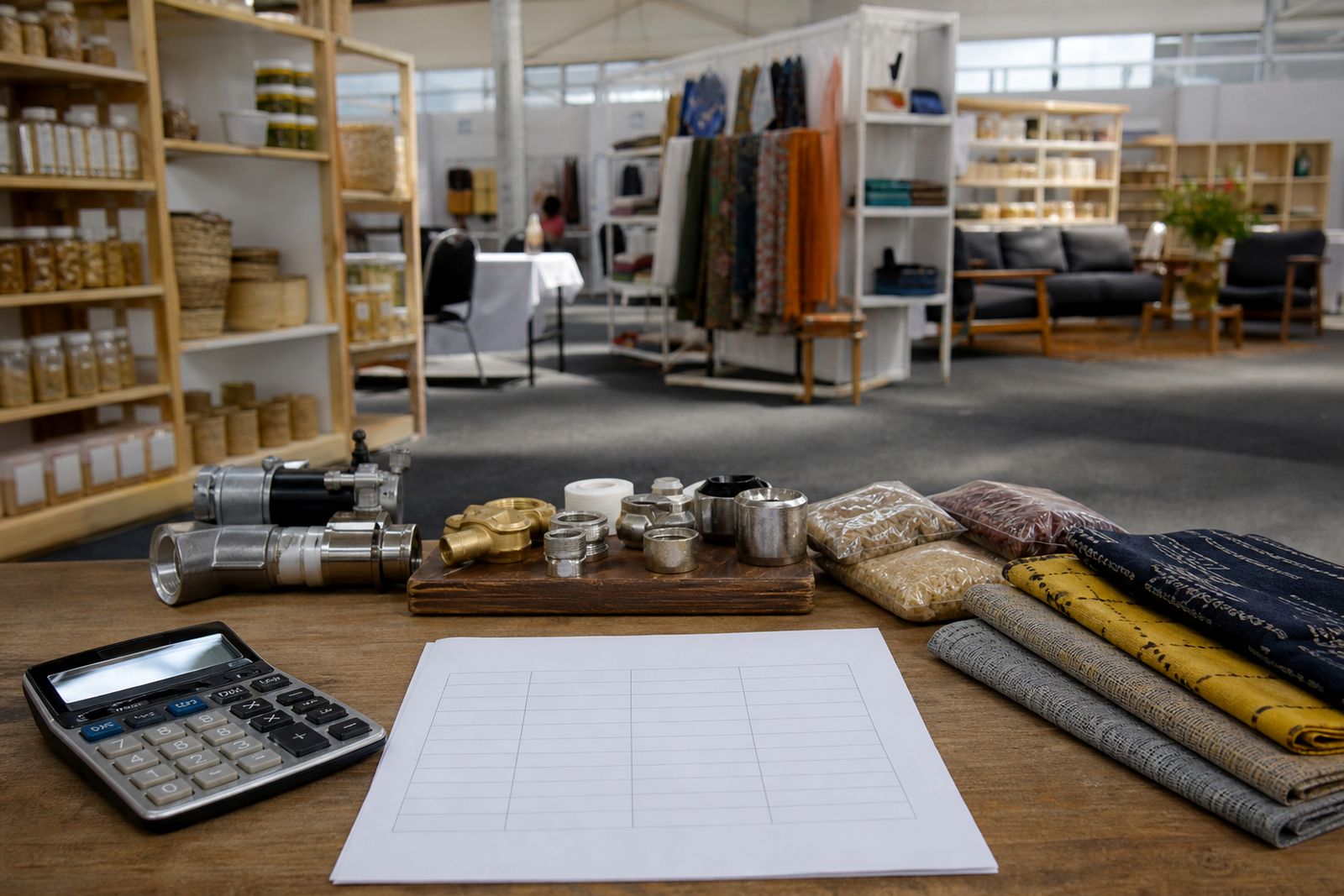
Start with the unit a buyer actually orders
The most common pricing problem at a manufacturers show is a sheet that lists figures without saying what the figure applies to. A buyer may be thinking in cartons, inners, pallets or single units, while the factory has priced only one of those. Before you print or share anything, decide what your main selling unit is and make it obvious on every line.
For many wholesale buyers, the useful starting point is the carton price, because that is how receiving, storage and branch allocation are often planned. For some categories, inner packs matter more. If your product is sold in singles but ships in cartons, show both. That saves time during meetings and avoids awkward recalculations on the floor.
- State the selling unit clearly: each, inner, carton, case, set or pallet.
- Show how many units are inside the pack.
- Add carton dimensions in centimetres and gross weight in kilograms where relevant.
- If mixed cartons are allowed, say the minimum mix and any conditions.
- Use one format throughout the document so buyers can scan it quickly.
If a buyer must ask what the price means, the sheet is not ready yet. Keep it plain, direct and easy to read even when someone is moving between appointments.
Separate product price from delivery and import-related costs
Buyers want to understand the product cost first, then the additional costs that may apply to getting goods from factory to Midrand or to a final delivery point. If these are blended together with no explanation, comparison becomes difficult. Your sheet should separate the ex-factory product price from transport, handling and any third-party charges.
This matters even more for cross-border trade. A buyer may collect from a local point, ask for delivery to a Johannesburg warehouse, or require onward distribution after the show. These are different cost pictures. If your offer can change depending on route or collection method, explain that in one note rather than leaving it for verbal discussion only.
- List the base price first.
- Show whether packaging for transport is included.
- State if local delivery in Gauteng is extra or included from a certain order level.
- Note whether cross-border clearing, inspections or document handling are excluded and billed separately by service providers.
- Make it clear when temporary sample movement is treated differently from sale stock.
A simple note such as “transport quoted on confirmed order quantity and delivery point” is often enough. It keeps the sheet honest and avoids a price being taken as final when route details are still unknown.
Include minimums, breaks and lead times buyers can plan around
Wholesale pricing works best when the buyer can see the commercial logic behind it. If your best price only applies at a larger volume, show the break points properly. If your factory needs a certain minimum order quantity to run efficiently, state it up front. Buyers are used to this, and it is better than agreeing a small opening order that cannot be repeated at the same level.
Lead time is just as important as price. A low figure means very little if replenishment takes too long for a promotion, store rollout or seasonal line. Give a realistic lead time from order confirmation, and mention whether it changes for first orders, repeat orders or custom packaging. Do not promise around production constraints. It causes trouble later.
If power cuts affect machining, printing, refrigeration or dispatch in your area, build in sensible margin and say that lead time is estimated from confirmed order details. Buyers appreciate a realistic sheet more than an optimistic one that keeps shifting.
- Show minimum order quantity per line or per range.
- Add volume breaks in a simple table style, for example 1 to 99 cartons, 100 to 299 cartons, 300 plus cartons.
- State lead time in working days or weeks from confirmed order.
- Say whether artwork approval, deposit, packaging confirmation or stock allocation must happen first.
- Note any seasonal raw material constraints if they affect availability.
Write the trade terms in plain language
A good wholesale price sheet does not try to become a full contract, but it should still cover the commercial points that buyers need before taking the next step. Keep these notes short and plain. Avoid long blocks of legal wording that slow down a meeting.
At a minimum, a buyer should be able to see what currency is being used, whether tax is included or excluded, how long the price is valid for, and what happens if input costs move before the order is confirmed. If your prices are in Rand, say so clearly. If you can quote in another currency on request, add a note rather than listing mixed currencies on one sheet.
Returns and damages should also be dealt with in simple terms. For example, say that shortages or transit damage must be reported within a stated inspection window after delivery. If custom-labelled goods are non-returnable except for defects, note that too. Short, practical wording works better than fine print that nobody reads on the day.
Make the sheet easy to compare during meetings
At the show, buyers often review several suppliers in one morning. Your pricing sheet should help them compare lines quickly without hunting for basics. Put your product code, description, unit, pack quantity and price in the same position on every row. If dimensions, colours or variants matter, keep the naming consistent.
Use short descriptions that identify the line properly. “Blue bottle 500 ml with cap” is more useful than “standard item”. If a product comes in a range, show whether the price applies to all variants or only selected ones. Where there are small price differences between colours, finishes or pack formats, mention them in one note instead of creating confusion across multiple pages.
It also helps to prepare one version for printed handover and one digital version for follow-up after the show. The digital version can include a few extra notes, but it should match the printed figures exactly. A buyer who sees two different prices later may stop the process there and then.
- Keep line descriptions short and specific.
- Use one currency only per sheet.
- Number the pages, especially if ranges run over more than one page.
- Add your company name and the range name at the top of each page.
- Leave space for buyer notes and requested amendments.
Final check before you bring pricing to Midrand
Before the show, run through the sheet as if you were the buyer. Can someone unfamiliar with your factory understand what is being sold, in what quantity, at what price, and under what timing? If not, fix that before printing. It is much easier to tidy a sheet in advance than to explain gaps in every meeting.
Ask your sales lead, production lead and finance contact to review the same version. Many pricing mistakes happen when one team updates costs but another team is still carrying an older pack size or lead time. One final check prevents embarrassment later and helps your team speak from the same page. Small errors on a price sheet can cost a real order.
- Check arithmetic on pack conversions and volume breaks.
- Confirm that product codes match cartons, labels and sample tags.
- Verify that lead times match current production capacity.
- Review exclusions so transport and document handling are not assumed to be included.
- Print clean copies and keep the source file ready for post-show follow-up.
If you are unsure how to present transport assumptions or export paperwork notes alongside pricing, raise those questions before the event through our contact page. It helps you arrive prepared, and buyers notice when a supplier is organised.
What our Exporter Trade Show customers say
Verified Google reviews
Questions we get asked
Should I price in Rand only?
If you are meeting buyers in Midrand, Rand is usually the simplest starting point for comparison. If you can quote in another currency on request, mention that in a note rather than mixing currencies on the same sheet.
Do I need to include delivery in my wholesale price?
Not always. Many exporters separate the base product price from delivery, handling and any third-party charges so the buyer can see the product cost clearly.
What is the biggest pricing mistake exporters make at the show?
The most common mistake is giving a price without the order unit, pack quantity or minimums. Buyers need to know exactly what quantity the figure applies to before they can compare offers properly.
Also worth a look



Exhibit or come to buy
Send a note through our contact form telling us whether you are a factory that wants to exhibit or a wholesaler or retailer coming to buy, and our team will reply with the next steps.
Open the contact form